

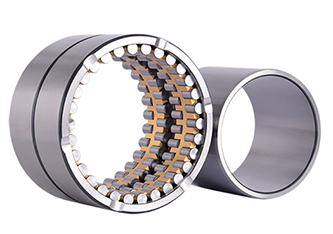
This four-row cylindrical roller bearing is engineered for hot strip mills, delivering exceptional performance under extreme radial loads and high impact shock in harsh steel plant environments.
 |
Boundary Dimensions | d | 180 | mm | |||
| D | 260 | mm | |||||
| B | 168 | mm | |||||
| Fw | 202 | mm | |||||
| Basic Load Ratings | Cr | 1040 | kN | ||||
| C0r | 2700 | kN | |||||
| Speed Ratings | Grease | 1740 | rpm | ||||
| Oil | 2140 | rpm | |||||
| Weight | 31 | Kg | |||||
| Equivalent | SKF | FAG | NSK | NTN | KOYO | TIMKEN | URB |
| 313812/ BC4-0114 | 507536 | 180RV2601 | 4R3628 | 313812W/36FC26168 | 180RY1521 | 4NNU5136PFC3W8 | |
Overview
This is a separable radial four-row cylindrical roller bearing. It is mainly installed on the work roll and backup roll of metal rolling mills. It effectively addresses challenges including heavy cyclic radial load, frequent start-stop, impact load and long-duration continuous operation under high-load rolling conditions.
Structural Features
1. Separable structure: inner ring assembly, outer ring and roller-cage assembly can be disassembled separately, facilitating mounting, disassembly and inspection.
2. Four rows of cylindrical rollers arranged in parallel, evenly distributing radial load across roller rows to reduce unit stress.
3. Machined brass or steel pressed cage guides rollers stably, preventing roller skew and friction.
4. No axial load carrying capacity; must be used together with axial positioning bearings to bear axial force.
5. Raceway and roller surfaces adopt optimized profile design to reduce edge stress concentration.
Load-Carrying Capacity & Performance
· Load: Excellent heavy radial load capacity; not suitable for bearing axial loads. Equipped with good resistance to shock and alternating loads.
· Speed: Moderate limiting speed, lower than single-row cylindrical roller bearings, suitable for low-to-medium speed heavy-duty operation.
· Lubrication: Grease lubrication or oil circulation lubrication is available; oil lubrication is preferred for high-temperature and continuous long-time working conditions.
· Operation: Low friction torque, stable running, small elastic deformation under heavy load, maintaining high rotational accuracy.
Material & Manufacturing
· Rolling elements and bearing rings: High carbon chromium bearing steel / GCr18Mo, with high hardness, wear resistance and contact fatigue resistance.
· Cage: Manganese brass cage.
· Heat treatment: Vacuum quenching and tempering, stable retained austenite, controlling dimensional change during long-term service.
· Machining: Precision grinding for raceways and rollers; strict dimensional sorting of rollers to guarantee uniform load sharing among four rows.
FAQ
Q1: Can four-row cylindrical roller bearings bear axial load?
A1: Generally, this type of bearing only carries pure radial load. It cannot sustain axial force. If axial load exists, separate thrust bearings or tapered roller bearings shall be arranged for axial positioning.
Q2: What lubrication method is recommended for rolling mill four-row cylindrical roller bearings?
A2: Oil circulation lubrication is the preferred solution for continuous rolling production. Grease lubrication is applicable for intermittent, low-duty working conditions. The lubricant grade should be selected according to operating temperature and peripheral speed.
Q3: Is it allowed to replace the bearing with a different brand equivalent model directly?
A3: Direct replacement is not allowed without verification. Confirm the bore, outer diameter, width, dynamic load rating, cage type and clearance group. The roll neck and housing fit also need rechecking.
Q4: What are the common failure causes of four-row cylindrical roller bearings in rolling mills?
A4: Typical causes include poor lubrication, foreign particle contamination, improper preload, roller skew, overload impact and misalignment between roll neck and bearing housing.
Q5: How to choose the internal clearance for four-row cylindrical roller bearings for rolling mills?
A5: The clearance group is selected based on fit, operating temperature and load. Larger clearance is usually adopted for hot rolling mills to compensate for thermal expansion of the roll neck.


 +86-13670502706
 overseas@esgbearing.com
 +86-13670502706
