
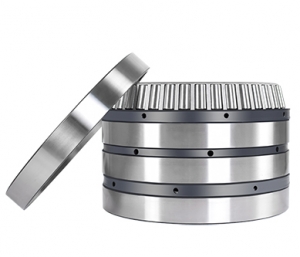
When it comes to load handling, four-row tapered roller bearings excel at accommodating radial and axial loads simultaneously. In terms of speed adaptability, they function effectively at low to moderate speeds, and their usage is almost restricted to work roll applications like rolling mills.
|
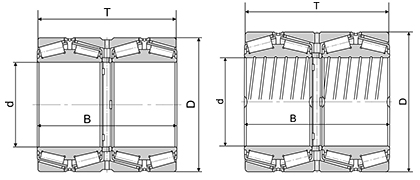
drawings may differ from products |
Boundary Dimensions |
d |
170 |
mm | |||
| D | 260 | mm | |||||
| B | 230 | mm | |||||
| T | 230 | mm | |||||
| Basic Load Ratings | Cr | 1030 | kN | ||||
| C0r | 3100 | kN | |||||
| Speed Ratings | Grease | 670 | rpm | ||||
| Oil | 850 | rpm | |||||
| Weight | 43.00 | kg | |||||
Product Type:Four-Row Tapered Roller Bearing
|
Dimension Type |
Value |
|
Inner Diameter (d) |
170mm |
|
Outer Diameter (D) |
260mm |
|
Thickness (B) |
230mm |
Radial Load Capacity: Radial load capacity is about 2.5-3.5 times stronger than single-row tapered roller bearings, ensuring reliable performance under high-load conditions.
Load Type Adaptability: Works well with combined radial and axial loads (radial loads being the main force) and can stand up to heavy loads and impact loads in harsh working environments.
|
Component |
Material |
|
Inner & Outer Rings |
Carburized Steel |
|
Rolling Elements |
Bearing Steel |
|
Cage |
Stamped Steel Plate |
Primary Application: Mainly used in work rolls and backup rolls of rolling mills, fully adapting to the harsh operating conditions of local rolling industry.
Other Applications: Suitable for various heavy-duty mechanical equipment such as cranes, mining machinery, and wind turbines, capable of withstanding high loads and impact loads in complex working environments.


 +86-13790878972
 overseas@esgbearing.com
 +86-13790878972