
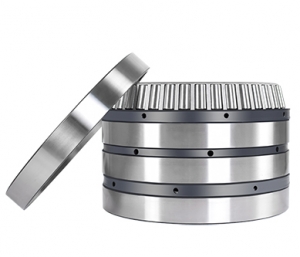
Four-row tapered roller bearings can take both radial and axial loads at the same time. They work pretty well when speeds are low to medium, and you’ll almost only find them in work roll setups—like rolling mills, for example.
|
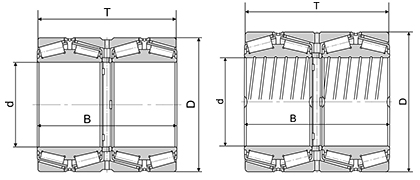
drawings may differ from products |
Boundary Dimensions |
d |
180 |
mm | |||
| D | 280 | mm | |||||
| B | 180 | mm | |||||
| T | 180 | mm | |||||
| Basic Load Ratings | Cr | 920 | kN | ||||
| C0r | 2540 | kN | |||||
| Speed Ratings | Grease | 670 | rpm | ||||
| Oil | 850 | rpm | |||||
| Weight | 39.60 | kg | |||||
Product Type:Four-Row Tapered Roller Bearing
|
Dimension Type |
Value |
|
Inner Diameter (d) |
180mm |
| Outer Diameter (D) |
280mm |
|
Thickness (B) |
180mm |
Radial Load Capacity: The radial load-carrying capability is roughly 2.5-3.5 times higher than that of single-row tapered roller bearings, meeting the requirements of high-precision industrial loads.
Load Type Adaptability: Tailored for combined radial and axial loads (with radial loads as the primary), it shows outstanding tolerance to heavy loads and impact loads.
|
Component |
Material |
|
Inner & Outer Rings |
Carburized Steel |
|
Rolling Elements |
Bearing Steel |
|
Cage |
Stamped Steel Plate |
Primary Application: Its design is specifically tailored for work rolls and backup rolls in rolling mills, making it an ideal match for the high-precision and heavy-load requirements characteristic of European mill equipment.
Other Applications: Beyond its primary use, it finds broad applicability in various heavy-duty machines, including cranes, mining machinery, and wind turbines, all of which demand superior performance under high and impactful loads.


 +86-13790878972
 overseas@esgbearing.com
 +86-13790878972