
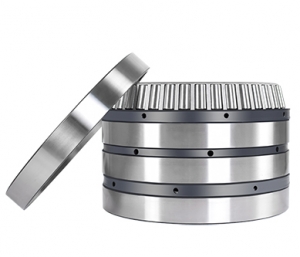
Four-row tapered roller bearings have two key perks: they manage radial and axial loads simultaneously, and run effectively at low-to-moderate speeds. They’re pretty much only used for work rolls, such as rolling mills.
|
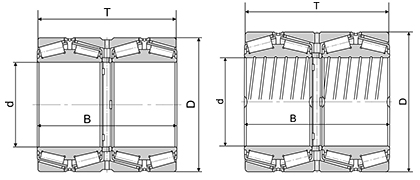
drawings may differ from products |
Boundary Dimensions |
d |
420 |
mm | |||
| D | 560 | mm | |||||
| B | 437 | mm | |||||
| T | 437 | mm | |||||
| Basic Load Ratings | Cr | 7900 | kN | ||||
| C0r | 16300 | kN | |||||
| Speed Ratings | Grease | 220 | rpm | ||||
| Oil | 300 | rpm | |||||
| Weight | 298.00 | kg | |||||
Product Type: Four-Row Tapered Roller Bearing
|
Dimension Type |
Value |
|
Inner Diameter (d) |
420mm |
| Outer Diameter (D) |
560mm |
| Thickness (B) |
437mm |
Radial Load Capacity: Boasting a 2.5–3.5x radial load capacity advantage over single-row tapered roller bearings, this bearing delivers guaranteed stable operation even in the most demanding high-load scenarios.
Load Type Adaptability: Unlike conventional bearings, it excels at combined radial-axial loads (radial as main force) and stands up to heavy/impact loads in harsh operating environments, making it a high-performance choice.
|
Component |
Material |
|
Inner & Outer Rings |
Carburized Steel |
|
Rolling Elements |
Bearing Steel |
|
Cage |
Stamped Steel Plate |
Primary Application: Rolling mill work/backup rolls (exclusive design) → fits European rolling mills’ high-precision, heavy-load standards.
Other Applications: Widely applied to heavy-duty equipment with high load/impact resistance demands: cranes, mining machinery, wind turbines.


 +86-13790878972
 overseas@esgbearing.com
 +86-13790878972