
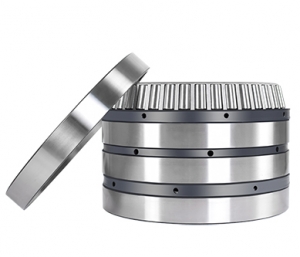
Radial and axial loads can be simultaneously accommodated by four-row tapered roller bearings, which excel in load handling. Effective function at low-to-moderate speeds is achieved in terms of speed adaptability, and usage of these bearings is almost restricted to work roll applications like rolling mills.
|
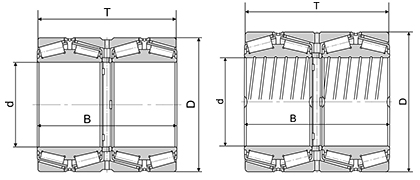
drawings may differ from products |
Boundary Dimensions |
d |
340 |
mm | |||
| D | 520 | mm | |||||
| B | 325 | mm | |||||
| T | 325 | mm | |||||
| Basic Load Ratings | Cr | 3100 | kN | ||||
| C0r | 8620 | kN | |||||
| Speed Ratings | Grease | 320 | rpm | ||||
| Oil | 400 | rpm | |||||
| Weight | 234.00 | kg | |||||
Product Type: Four-Row Tapered Roller Bearing
|
Dimension Type |
Value |
|
Inner Diameter (d) |
340mm |
| Outer Diameter (D) |
520mm |
| Thickness (B) |
325mm |
Radial Load Capacity: Let’s put it simply—its radial load capacity is about 2.5 to 3.5 times stronger than single-row tapered roller bearings. That means it works reliably even when under heavy loads.
Load Type Adaptability: It works great with both radial and axial loads (radial is the main one) and can take heavy loads and impact loads, even in tough working environments.
|
Component |
Material |
|
Inner & Outer Rings |
Carburized Steel |
|
Rolling Elements |
Bearing Steel |
|
Cage |
Stamped Steel Plate |
Primary Application: Engineered exclusively for work rolls and backup rolls of rolling mills, it is a perfect match for European rolling mill equipment’s strict high-precision and heavy-load requirements.
Other Applications: Beyond rolling mills, it is widely used in heavy-duty machinery (cranes, mining equipment, wind turbines) that demands excellent resistance to high loads and impact loads.


 +86-13670502706
 overseas@esgbearing.com
 +86-13670502706