
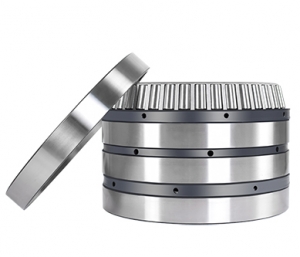
What do four-row tapered roller bearings do? Handle radial and axial loads at once, work well at low-to-moderate speeds—and they’re nearly only used in work roll scenarios, like rolling mills.
|
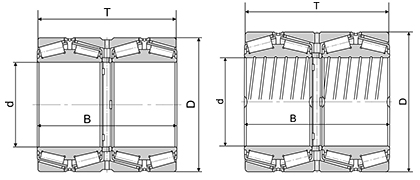
drawings may differ from products |
Boundary Dimensions |
d |
420 |
mm | |||
| D | 620 | mm | |||||
| B | 356 | mm | |||||
| T | 356 | mm | |||||
| Basic Load Ratings | Cr | 4160 | kN | ||||
| C0r | 10400 | kN | |||||
| Speed Ratings | Grease | 220 | rpm | ||||
| Oil | 300 | rpm | |||||
| Weight | 360.00 | kg | |||||
Product Type: Four-Row Tapered Roller Bearing
|
Dimension Type |
Value |
|
Inner Diameter (d) |
420mm |
| Outer Diameter (D) |
620mm |
| Thickness (B) |
356mm |
Radial Load Capacity: The bearing’s standout feature is its radial load capacity—approximately 2.5–3.5 times that of single-row tapered roller bearings—ensuring stable operation when high loads are applied.
Load Type Adaptability: It excels in two critical areas: handling combined radial-axial loads (radial dominant) and withstanding heavy/impact loads in harsh environments, maximizing operational reliability.
|
Component |
Material |
|
Inner & Outer Rings |
Carburized Steel |
|
Rolling Elements |
Bearing Steel |
|
Cage |
Stamped Steel Plate |
Primary Application: This product is specifically engineered for the work rolls and backup rolls of rolling mills, and it perfectly aligns with the stringent high-precision and heavy-load operational requirements of European rolling mill equipment.
Other Applications: It boasts broad applicability across a range of heavy-duty mechanical equipment, including cranes, mining machinery, and wind turbines—all of which mandate exceptional resistance to high loads and impact loads.


 +86-13790878972
 overseas@esgbearing.com
 +86-13790878972